Join Penn State alumna, Carly Glova, ’08 Finance, for a Smeal Lifelong Learning Webinar, “It’s a Candidate’s Job Market: How to Succeed in It,” on Wednesday, September 12, at Noon ET/9:00 AM PST. Reportedly, the economy’s strengthening and both jobs and wages are moving up. Carly, Founder and Executive Recruiter at Building Careers LLC, will discuss how employers and employees can survive in this war for talent! Secure your spot today! https://bit.ly/2IqHZt
Once you have connected with a candidate’s former supervisor or colleague, here are a few questions to ask:
1. Tell me about your experience
2. Major accomplishments
3. Skill ratings
4. Strengths
5. Weaknesses
6. Communication style
7. Why did they leave?
8. Would you rehire them?
I would also recommend asking about:
1. Candidate’s responsibilities
2. Technology familiarity and specific systems
3. Ability to meet deadlines
4. How they took feedback
Asking open-ended questions will really allow you to get a sense of how that employee functioned in that specific role and how they might be a fit for your company.
So you didn’t get the job or the second interview or maybe you didn’t even receive any feedback after submitting your resume. Sound familiar? While there are a myriad of possible reasons why you didn’t get the job, here are some of the most common reasons.
Resume
Your first introduction to a company is your resume. Studies have shown that hiring managers spend an average of 6 seconds reviewing a resume, so it could be that you didn’t have the right keywords or easy to read formatting to allow the hiring manager to clearly understand your experience and how it relates to the role they are looking to fill at their company. Some companies also put a strong emphasis on pedigree, so if you haven’t worked at a large, institutional company for example, you may automatically be out of the running for certain opportunities where that experience is preferred (and vice versa). Companies also might be looking for specific certifications/licenses that are an automatic deal breaker if you don’t have them, for example CFA, CPM, CPA, etc
Personality and Culture Fit
In this day and age, personality match and culture fit are the second most sought after job must-haves for candidates (after career growth opportunities). Companies know this too and approach the hunt to fill a position with a large emphasis on scenarios like, are someone they could sit next to on a cross country plane flight? Nearly half of the companies that we work with have gone so far as to ask candidates to complete personality assessments and based on historical data/experience and other personality types in the office, decide whether or not you will be a fit within the company and/or specific team you’ll be working with. Other personality fit deciding factors include succinctness of communication, the way you carry yourself, the questions you ask, how you interact in interviews, and how you relay your excitement for the role.
Skill Set
Some roles require more soft skills, while others required a very specific skill set. For example, a company looking for an experienced commercial real estate analyst will be looking for someone with real-world experience in the software program Argus. More and more companies are starting to test for these hard skill sets as part of the interview process.
Experience
In the current economy, everyone is busy and hiring managers have a lot on their plate. “We need someone that can hit the ground running” is a phrase we hear a lot as many companies cannot dedicate the time and resources it takes to train someone into a role. Years of experience relative to the job and your reputation in the industry are two common deciding factors on whether or not you get the job.
Competition
As solid as your resume, personality, and skill set may be, you are also still compared to the other candidates interviewing for the job.
Compensation
You may have priced yourself out of a role. Perhaps you are more expensive relative to your competition. While this does factor into a hiring decision, we don’t see this as much because most companies are willing to meet compensation requirements for the right fit of all of the above.
External Factors
There could be a variety of external reasons that you didn’t get the job. A company reorganization, budget issues, an earthquake – you name it. Perhaps the company promoted someone internally or received a referral from a trusted source. Or maybe the company decided they don’t need anyone in that role after all and closed the position. Maybe they decided to outsource the role to a 3rd party.
Realistically, you will may never know specifically why you didn’t get hired. Whatever the reasons are, either internal or external, know that the right job for you is out there. Continue to focus on your job search, trying to improve each time and doing your best to not take negative outcomes personally.
Many of our clients value the skills that a property manager brings to the asset management side. Find out how to avoid roadblocks and think in terms of value-creation and financials if you are considering making the transition.
A few tips include:
Become familiar with the finance side of the assets
Prepare to take a step backwards (in title and financially) in order to learn the analytical aspects
Think about ways to enhance property value and financial performance and effectively get clients on board with those programs
Originally published by John Salustri on GlobeSt.com on April 2, 2018
Building Careers is sitting down with the movers and shakers of the commercial real estate scene here in San Diego to find out how they got to where they are and what they want to see in people on their team.
Kicking off our blog series, I wanted to give you a sneak peak of the Q&A you can expect with some of my own thoughts.
Describe your background and how you got into the industry.
Architecture and home design always interested in me, but learning that I could apply intangible finance underwriting to commercial buildings that everyone could see, touch, and have an opinion on opened up a whole new world of possibilities for me. This light bulb went off when I stumbled upon a commercial real estate finance course while I was an undergrad at Penn State. From there, I worked in the industry in a finance consulting capacity, on the private equity side, and in-house for an investor, developer and operator.
I came upon a career crossroads. After conversation after conversation with many of you fantastic mentors and role models in the San Diego commercial real estate world, I realized that I wanted to have those types of conversations on a daily basis. I wanted to be that sounding board and advisor to anyone at any stage in their career to ensure that their role aligned with their life goals and motivations. What better place to do that than in the commercial real estate industry that I know and love? Since founding my executive search and recruiting firm, Building Careers, I am motivated every day by inspiring people to succeed.
What exciting projects are you working on?
My team and I are currently working on finding the right fit for an acquisitions analyst, development director, senior design manager, controller, lease administrator, corporate finance director, project and construction managers, and acquisitions, leasing, and asset management senior associates, among others. We are consistently recruiting for exciting opportunities with growing companies, so if you want to stay up to date on open commercial real estate career opportunities, visit the job page of our website or email me. I look forward to hearing from you!
What are you seeing in terms of hiring?
It is a candidate’s market right now. Quality talent that aligns with each company’s specific culture and way of working is very difficult to find. When companies identify someone that aligns with what they want on their team, I would recommend that they be ready to make a strong offer and on-board that person quickly. Offers that allow candidates to feel valued by the company and communicate to them that the company is invested in their long-term career growth are extremely effective in the current market. Knowing and living your company culture everyday will make an efficient hiring process more seamless.
What can candidates do to stand out?
Candidates who know themselves and what they bring to the table set themselves apart from the rest of the pack. Those who can clearly communicate their value through concise examples put themselves in a position that aligns with their strong suits. Operating this way is paramount in achieving long-term success for not only the employee, but for the employer as well. As a resume is most often a candidate’s first impression, stay tuned next month for additional suggestions on putting your best foot forward through your resume.
What is your one piece of advice for folks trying to make it in the commercial real estate industry?
Make meaningful connections with those that you cross paths with in your professional network. Having advocates and sponsors as resources is essential to career growth and learning, especially in the commercial real estate industry.
Interested in hearing more from some of the industry’s leading faces? Be on the lookout for future interviews!
When is the last time you took a good hard look at your career path? How far you’ve come and where you want to go. It’s never too late, or too early, to set yourself up in your current job to get that promotion, be selected for a new position or find yourself recruited by another organization altogether. Here are five tips to help you prepare for and execute on your next big move.
Let your advocates know
Tell your trusted network about your job aspirations. These friends and colleagues can offer the
advice, insights and introductions that will help you advance in your career – one of them may
even advocate to bring you along with them! And, of course, it’s always a good idea to have a
recruiter as part of your support team. Recruiters are well-networked and when we’re made
aware of what you’re looking for, we will find you matching job opportunities.
Share your progress and success
It’s hard to boast about yourself. And there’s a time and place for it and proper way to do
it. But unless the decision makers in your company (or at the company where you
want to transition to) know about your contributions and the value you bring, they won’t have the
information they need to confidently offer you more responsibility or a new role. Day to day,
keep your head down and get the job done. It’s a great work ethic! But when the time comes –
during a review or a casual walk to grab coffee – be prepared with examples of your
accomplishments to let the right people know what you have been up to.
Keep learning
Continuing your education and professional development is important and can be fun at
any stage of career. When you have decided what your next move is going to be,
go back to the classroom to take a related course or shadow someone in your company.
It will strengthen your marketability and bring you that much closer to the job you seek.
Mentor others
Being a manager comes with great responsibility and the opportunity to truly mentor. Imparting your knowledge and experience will help your team members grow in their careers and allows you to continue to grow in your own.
RSVP Yes
Accept the work and outside-of-work invitations even when you’re buried in emails or so
tired all you want is your couch. You’ll meet someone new, learn something new and inevitably
hear about a new job opportunity. And when that great opportunity presents itself, even if it’s
intimidating, take it!
“If someone offers you an amazing opportunity and you’re not sure you can do it,
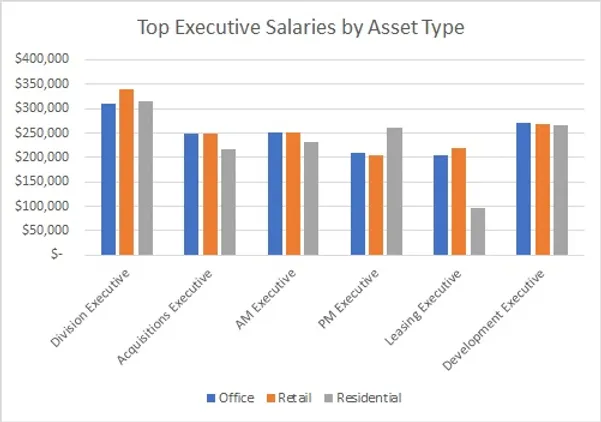
It’s 2018. It’s January. It’s the start of new resolutions and a great time to look at where we are in our careers. For many, it might also be time for our annual reviews and bonus and promotion discussions. The insightful 2017 Real Estate Compensation Survey conducted by CEL & Associates, Inc. lists the many real estate industry jobs out there and their associated salaries and bonuses.
I pulled together the below charts to provide a visual representation that highlights select roles and role levels.
Working with folks in these positions daily, I want to share with you some observations that I took from the compensation study:
Roles in the residential arena pay significantly less than office and retail, with retail real estate roles paying the most. It will be interesting to see how those trends develop as our industry continues to evolve.
Roles in leasing tend to have a larger percentage of their compensation rooted in bonus, so while their base salaries may be lower, their bonuses are higher. This isn’t as apparent in residential leasing, however.
As you would expect, the higher the level of position, people tend to receive a larger bonus as a percent of their salary, so not only is the bonus percentage increasing with seniority, but the base number that it is based on increases as well.
As a general proxy, based on a small sample size of numbers I tested compared with average salaries I have seen in the local market, San Diego pays about 10% less than the national median numbers published in this survey.
Stay tuned as we provide some inspirational insights next month regarding how to springboard your career in the direction of those executive roles (and compensation packages!).
*Thank you to CEL & Associates, Inc. for the information.
Please note that the compensation figures presented represent a composite of all companies participating in the 2017 CEL National Survey and are not stratified by
ownership/type of company (public vs. private), company size, product specialization, regional geographic location, or metropolitan area. Further, factors such as tenure,
experience, role and responsibility will impact compensation levels and benchmarks (percentiles) for the evaluation of any comparative situation, as will the financial situation of
a company and its investment and business strategy.
(1) High = 75th percentile, Median = 50th percentile, Low = 25th percentile.
Survey Completed 2Q 2017.
Source: CEL Associates, Inc./CEL Compensation Advisors, LLC (c) 2017 National Real Estate Compensation Survey – All Rights Reserved. Not to be referenced or
reproduced in any form without prior permission in writing: 12121 Wilshire Blvd., Suite 204, Los Angeles, CA 90025 Tel. (310) 571-3113, Fax. (310) 571-3117.
This month, we decided to try something different for a bit of fun. We invite you to tell us what your “Dream Job” is for the chance to win access to one commercial real estate industry event of the winner’s choosing every month in Q2 2017 compliments of the Building Careers Team. This can include any of the impressive local and national events and conferences put on by industry organizations such as NAIOP, CREW, ULI, Bisnow, ICSC, SIOR, BOMA, IREM, RealShare, Connect, etc. Your chosen events are amazing opportunities to network, hear from industry experts/speakers, and invest in your career.
There are two steps to the process.
The first step is to write one or two brief paragraphs about your dream job. It could be the job you dreamed of as a child or the job in the profession or field you studied in college that has been eluding you ever since. It could even be related to the skills you are currently applying to a hobby but you know could also be used to earn a living. How you write your description is entirely up to you. Here are some ideas for what you could include for details: Job responsibilities, title/level of position, area of real estate expertise, salary, skills, location/city, team culture and environment. Please remember to include your contact information!
The second step is to email us your “Dream Job” description by March 31, 2017. Every job description will be entered into the drawing and on March 31, 2017 we will randomly select one entry from the group of submissions. That professional will be contacted and we will arrange for them to attend their chosen events. For everyone else, we will contact you to discuss career opportunities unless you indicated you are not interested in a conversation.
We hope you’ll participate whether you’re actively searching for a new job or not. This exercise gives you the chance to think about and “put in writing” your dream job, which brings you that much closer to achieving it. It also gives us the chance to get to know you and help many of you turn your dream job into reality.
It looks good for job seekers exploring employment opportunities in San Diego this year and the news comes from some of the best recruiters in town – Brett Wayne, Managing Director at Cypress HCM, Jeff Prekker, CEO at BioPhase Solutions, Kat Zorko, Director of Business Development at Sayva Solutions, and Nicole Sutton, Founder at Nexus Search Group, LLC. A big thanks to these impactful recruiters for taking the time to share your expert insights and advice…
How does it look for job seekers in 2017?
Brett: It should be a great year to search for a new position. The demand for top talent far outweighs the supply, which makes for a good situation for job seekers. This is especially true in the technology sector where companies are putting a premium on identifying talent to build out their teams.
Jeff: Definitely a candidate-driven market out there currently.
Kat: In regards to accounting and finance, employment outlook is positive for 2017. Unemployment remained low at the end of 2016 in San Diego, and skilled professionals remain in demand. San Diego’s larger employers continue to hire at a steady rate through growth, special projects, and movement while small to mid-size companies continue to provide opportunities. Potential challenges this year include shakeout from the election and how that impacts funding and IPO potential for employers as well as the continued effect of employers moving headquarters out of San Diego.
Nicole: Continue to be a demand for those with experience in bio-tech, health care and real estate. More opportunities for advancement as baby boomers continue to retire. More opportunities in San Diego’s strong and thriving start-up community.
What would your #1 piece of advice be for someone looking to change jobs in 2017?
Brett: Although it is a great time to be a job seeker, simply applying to online posts is not the best approach and should be a last resort. A better option is to network and utilize former colleagues or connections to introduce you to hiring managers and/or internal recruiters at the companies you would like to work. Another good option is to go through recruiting firms because they will be able to get your resume to the top of the pile and ensure the right set of eyes are reviewing the resume. If discretion is important and you don’t want to post your resume on Dice, Monster or Indeed, you can build out your LinkedIn profile and savvy recruiters will take that as a sign that you might be interested in hearing about new opportunities.
Jeff: Put a lot of thought into what your ideal position is and try to find something as close to that as possible. Put a good amount of thought into how you articulate why that particular position and organization are a great match for both the employer and for you.
Kat: Network! Do not rely on online applications to be the source of your next job. Build relationships and find ways to partner with people that will be mutually beneficial. Do not wait until you need a job to initiate this as well. Networking requires an investment of time and energy that can yield long-term results. I also recommend finding ways to differentiate yourself on your resume, your LinkedIn profile, your interview style, etc. San Diego in general is a competitive, saturated market given that it is an ideal place to live, so it requires a constant effort to stand out to be considered amongst your peers.
Nicole: Find a mentor in your particular field. Spruce up your social media presence – make sure your LinkedIn profile is updated and professional. Get out there and meet people! Networking is still the key to finding your next position. Work with a recruiter who not only knows your industry but your town too!
Any tips on how a job seeker can make himself/herself stand out
amongst the hundreds of 2017 resumes?
Brett: Building out a clean resume that is easy to read and highlights your most relevant skills is a great place to start. Recruiters and hiring managers spend about 15-30 seconds scanning resumes before moving on to the next one so it needs to be clear and concise. Once getting to the interview stage, it is important that you are prepared and do a lot of research on the company, position and interviewer.
Jeff: Find an internal employee that you know and have him/her talk to management and/or HR about you. Ideally mention that connection when applying.
Kat: Customize your resume to whatever job you are pursuing. Draw attention to related skills, experiences and accomplishments. Use powerful, strong wording and make your resume show what value YOU bring to an organization. Complement the resume with a strong LinkedIn profile and of course make sure there are no errors on either.
Nicole: Tailor your resume to the specific job you are applying for. Get as many buzz words in your resume as possible.
Meet the Experts – Some of the best recruiters in San Diego:
Check back next month for additional insight from our experts in our February Blog:
Tips for companies looking to hire quality employees in 2017
Most of us crave security and can rationalize it in a job. The best way to improve your skills and to challenge yourself is to explore opportunities that fill all of your motivations. Here are 10 good reasons to explore more relatively frequent job changes.
1. Learning a new work environment and dynamics exponentially strengthens your internal consulting skills.
2. Changing roles allows you to be more adept at recognizing rewarding vs. toxic workplaces and how to identify the healthier structures.
3. More frequent job changes provides you with more real-life success examples for other potential interviews down the line.
4. Exposure to a new company maintains and grows your professional network.
5. Job hunting allows you to practice and refine your professional brand.
6. When you focus all your professional energy on doing a good job for one employer, your focus turns to internal politics. Entertaining other opportunities every few years keeps you attuned to the world outside your cubicle walls.
7. When you job-hunt every three to five years, you know your market value.
8. When you experience new companies every few years, you get used to picking up new protocols, procedures, strategies and practices quickly.
9. When you get stuck in place at one job, you fall out of practice interviewing.
10. When you change jobs more often, you realize that there are a lot of people in the world and not all of them need to approve of you. That’s okay. You don’t need the whole world to love you. You only need to find the people who get you — and thus deserve your talents!