
Interview Tips

Ghosting Consequences Can Hurt Your Career

If you’re guilty of ghosting in the workplace, you may think the consequences will be small or nonexistent. But think again. There are several reasons you don’t want to slight others with your indifference – even in a strong economy.

What is Workplace Ghosting?

In recent years, job seekers in all industries – not just commercial real estate – have increasingly failed to show up for interviews or for their first day of work. Many are even walking off the job without notice. Others ghost their peers and colleagues by ignoring repeated voicemails and emails, thinking it’s no big deal.

But it is a big deal. And it’s getting bigger.

According to a recent study by research firm Clutch, a whopping 71% of job seekers have abandoned a job application with no notice. And nearly half stated it’s reasonable to ghost a company during the application process. Reasons for ghosting include:

  • Accepting a competing job offer
  • Unsatisfactory response from the potential employer
  • Deciding against the role

The prevailing theory as to why ghosting is becoming so prominent is the job market. It’s now a job seeker’s market, and candidates go where they are treated best. A type of nomad economy has replaced the old paradigm of working forty years at the same place and getting a gold watch.

Opportunities abound, so if an interview process grows tiresome, there are second thoughts about an accepted job offer, or you don’t feel like turning in your two-weeks’ notice, you walk. But what are the consequences of ghosting in the workplace?

Negative Ghosting Consequences

1. Diminished Trust

Trust is essential in any career. Brokers must be trusted by their principals. Appraisers must be trusted by their clients. Assistants must be trusted by their bosses to handle the essential responsibilities that make their job so necessary. Trust is directly linked to value. And when you can’t be relied upon to show up or provide notice or follow through, your career value drops.

2. Damaged Relationships Relationships with others in our industry are vital to our career success. The hiring manager you ghosted after the first interview may well be your boss at another job. The recruiter you stopped replying to will remember your name next time you are on the beach.

3. Uncertainty While the CRE job market remains strong, and by all signals will continue strong for the near future, you never know when it will change. Developing and nurturing a reputation of trust and follow-through may not seem that important right now, but it will be vital to your career next time things swing the other way. Just a few years ago, it was the employers ghosting candidates because they had their pick. A few years from now, that could very well be the case again.

Additionally, as employment specialist John Feldmann points out in Forbes, respect and the Golden Rule should be our number-one consideration in the workplace. You might score a really good job by taking an offer after already accepting another. But is that the kind of team member you want to be? Is that the kind of reputation you want? Isn’t your career about more than getting ahead for the moment at the expense of others?

It’s not just about ghosting consequences in the here and now. It’s about being considerate to others, knowing full well that it will come back around to you.

Ghosting Consequences Can Hurt Your Career Read More »

How To: Stand Out in an In-Person Interview

So you made it past the application, the phone interview…congratulations! Now you’re probably wondering how to stand out in an in-person interview? Coco Chanel says, “In order to be irreplaceable, one must always be different.” Sure, conventionality is safe and familiar, but is it memorable? Not always. But here’s a secret: they’re not mutually exclusive. You can be a traditionally professional candidate while still infusing extraordinary aspects to your interview. Be bold with your approach, and aim to not only be the most memorable candidate, but the best one too. Here are some ways to stand out in an in-person interview that the Building Careers RE team loves!

Stand Out in an In-Person Interview

Nail The “Tell Me About Yourself” Question

This will be one of the first questions you receive, and it’s a stellar opportunity to set the bar really high. Many people struggle with this expansive question, but if you can craft a narrative that speaks to your strengths, experiences, and interest in the job, you will be five steps ahead of the competition.

Find a Common Interest

Connecting on something in common is a great way for your interviewer to remember who you are. If you find a shared interest in documentary films, or maybe a love for a preferred app, take the time to make this connection clear. Just be aware of when it’s time to move on.

Learn more ways to stand out in an interview here: https://www.glassdoor.com/blog/11-unusual-ways-to-stand-out-in-a-job-interview/

How To: Stand Out in an In-Person Interview Read More »

6 Ways to Build a Resume That Stands Out

Customize Your Resume For Your Industry

Whether you’re deciding to switch jobs for the third time, or applying for the first time, the job application process can be overwhelming. Especially when trying to create a resume that stands out. Hiring managers don’t have a ton of time to thoroughly look over each resume, which means you have to be considerate about what to include. From choosing the right font to deciding whether or not to include that internship, creating a resume in 2020 isn’t easy. So how do you make your resume stand out among hundreds of applicants? Consider these six tips from top HR executives Time Magazine interviewed.

People are often encouraged to include personality in their resume, but unless they are applying for a job in a creative industry, they may want to rethink that strategy. “A lot of pictures and fonts and colors and a whole lot of personality just doesn’t align with the jobs we have here,” says Schweikert, whose team recruits for positions in sales, product, and marketing. “If I was in an organization that, for example, was in web design, then I would want to see those design elements in a resume.”

Include Keywords From The Original Job Posting

One of the best ways to make your resume stand out is to use the job posting as a guide. Some companies conduct keyword searches when sorting through resumes. Schweikert adds, “which means those terms are even more important to include if you want to secure an interview. It may sound tedious, but taking the time to customize your resume for each job you apply to is a surefire tactic to stand out among the pack of applicants,” she says.

Learn More: https://time.com/5483970/how-to-write-a-resume-that-stands-out/

6 Ways to Build a Resume That Stands Out Read More »

8 Job Interview Questions Companies Will Ask You

Preparing for job interviews can often feel like an impossible task. With so many potential questions that an interviewer could ask you, how can you realistically practice answering each one? The good news is that most interviews are based on a cache of basic questions that you’re almost certain to be asked in one form or another. These are questions to determine who you are, why you’re interviewing at the company, and what you will bring to the role.

“In the job interview, you are literally auditioning for a new role,” writes Cathy Salit in the Harvard Business Review. “Like any good performer, you need to practice in advance,” she says. Use the tips here to craft your authentic response to commonly asked interview questions. Think about related questions that these answers could also be used for. Then take the time to craft a full response and rehearse saying it out loud — practice makes perfect!

1. What Interests You About This Position?

This is one of the most important questions you’ll be asked, so feel free to really think this one through. This is basically your chance to show the interviewer why you’ll be a perfect fit for the role, and what about the role and company attracts you. To give a full answer, you can tell an anecdote about how your background has led you to applying for this position, and how this role is critical for moving you forward in your career.

Learn More at: https://www.glassdoor.com/blog/questions-nearly-every-job-interview/

8 Job Interview Questions Companies Will Ask You Read More »

The 4 Absolutely Best Ways to Prepare for an Interview

Most people dread having to prepare for an interview. It’s laborious. They aren’t entirely sure what they should rehearse or study. And they really just want the interview to be done and over with so they can learn if they got the job or not.

But understanding how to prepare for an interview is a superpower in the CRE field. We’ve written on interview prep skills before, because it’s so crucial to a successful career. This key skill will enable you to control so much about the interview itself and whether or not you get the job. To simplify, there are four basic ways to prepare for an interview. Whether you are competing for a job as an analyst, associate, or project manager, these principles are the same. Cover these four bases, and you will greatly improve your chances of scoring that dream job.

1. Do the Homework

Your knowledge of the company, role, and industry are crucial to solid interview performance. Know your stuff. Here are some of the key points to research in mastering this area of preparation:

  • The Company Don’t just skim their website and LinkedIn. Spend time on their social media pages, blogs, and Google reviews, etc. Find out what others say about them. Is this a good place to land?
  • The Culture Peruse social media platforms to find out how employees interact. Are they playful, somber, casual, formal? Check out their mission and values. How do these intersect with your own? Even their mission statement and words they employ on their website can give you an indication of the company culture.
  • The Team Go the extra mile and stalk the hiring team. No, not in a creepy way – but you want to understand their frame of reference and backgrounds at a reasonable level to be able to build rapport.
  • The Job Make sure you have a firm grasp on what this company is looking for and the requirements. Understand the main responsibilities of this position.

2. Prepare Your Responses and Questions

An interview is of course a series of questions and responses. So a crucial way to prepare for an interview is to prepare a list of common interview questions and prepare your tailored responses to each. Your list should include at least ten questions and answers. But at a minimum, be prepared for these three common commercial real estate interview questions:

  • Long-Term Goals Hiring the wrong fit costs the company time and money. They want to know your goals align with theirs. So find out what those goals are, and prepare to explain how they sync with your own.
  • Excel Skill Level This is a big one in CRE. So many positions require a deep understanding of Microsoft Excel from analyst roles to property management positions. So be ready to discuss your proficiency with this program.
  • About Yourself Last but certainly not least, you will at some point be asked to tell the team about yourself. This is not the time to disclose your personal hobbies and family history. The hiring manager wants to know how you got to this point in your career, what your approach and style are, and some key accomplishments.
  • Questions for the Team

Allow the person interviewing to be in charge of the discussion, but try to ask a few questions. Be

sure the questions reflect your commitment and desire to work for the company.

3. Look the Part

To prepare for an interview, you must look the part. This includes not only the clothes you choose to wear to the interview, but also the accessories you bring, the organization of your papers, and how you handle yourself. It’s important to make the right first impression. Here are some key aspects of looking the part:

  • The Outfit Don’t just dust off your old interview suit from your last job; wear something modern and tailored. Make sure it is pressed and cleaned. Not sure what is appropriate? Hang out at the café across the street to see what employees are wearing and then take it up a notch. Or ask the hiring manager what is appropriate. It is always better to be overdressed.
  • Grooming Yes, people will notice if your fingernails are not trimmed or if you haven’t shaved in a couple days. Do what it takes to feel good about yourself and present a polished package. This will translate into confidence in the interview.
  • The Briefcase Whether you bring a bag or briefcase, make sure it is adequately packed and organized. Include at least five copies of your resume, breath mints, a stain stick, a notepad, etc. And reduce the clutter. You want to be smooth and collected, not digging through a pile of stuff. Keep your cellphone stowed and off to avoid distracting disruptions.

4. Hone Your Outlook

Lastly, prepare for an interview by getting your head in the game and developing your outlook for success:

  • Career Highlights Before the interview, be prepared for unexpected questions by thinking over the highlights of your career: where you have struggled, how you overcame, and what you have learned and accomplished.
  • Body Language Check yourself to make sure your body language is open and confident while rehearsing your responses. Don’t come off as shifty, nervous, overbearing, or closed down.
  • Sleep It sounds simple, but get enough sleep before the interview. Your mind needs rest to prepare for an interview!
  • Ask! Though often overlooked, it is especially important in the highly competitive CRE industry to come right out and state your interest in the job. Ask for the job! Expressing your interest in an interview is crucial. It shows your eagerness and willingness to become a part of the team.

Sources:

The 4 Absolutely Best Ways to Prepare for an Interview Read More »

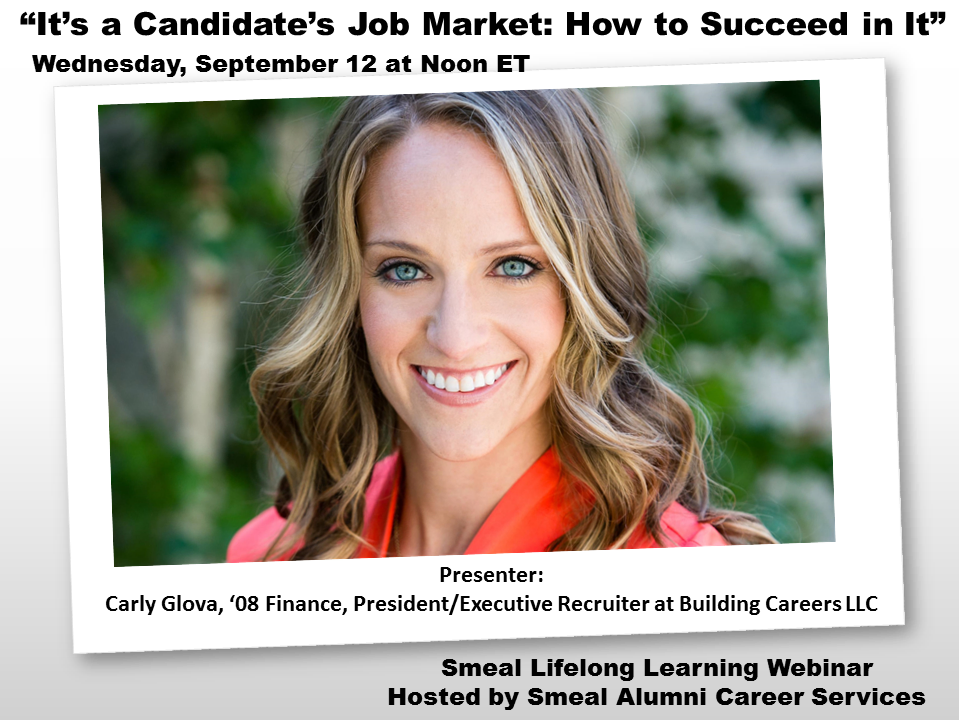
Webinar: It’s a Candidate’s Job Market: How to Succeed In It

In September, Carly collaborated with her alma mater to host a webinar specific to the current candidate’s job market. If you weren’t able to attend, please view the webinar in the link below.

Webinar: It’s a Candidate’s Job Market: How to Succeed In It

How to Stand Out in a Candidate's Market | How Candidates Can Succeed | How Companies Can Thrive and Hire Well

Carly Glova is the Founder and President of Building Careers, an executive search firm serving the commercial real estate world. Having determined that no executive recruiting firms in San Diego focused exclusively on supplying talent to the commercial real estate industry, Carly decided to take a risk and establish a firm that would have this specific market focus. In transitioning to recruiting, Carly used her affinity for and knowledge of the commercial real estate industry to make a difference in other people’s careers and inspire both employees and companies to succeed. What does a candidate-driven job market mean for me? What does it mean for my company? Feeling stuck or conflicted in your career choices or having trouble assessing or fulfilling the motivations of potential new hires? This increasingly prevalent market trend affects hiring and career decisions and adds a sense of urgency to the process. Carly aimed to prepare employers and employees alike for how to handle hiring and how to stand out in this war for talent. Check out her tips and tricks on how to crack a candidate’s market!

Webinar: It’s a Candidate’s Job Market: How to Succeed In It Read More »

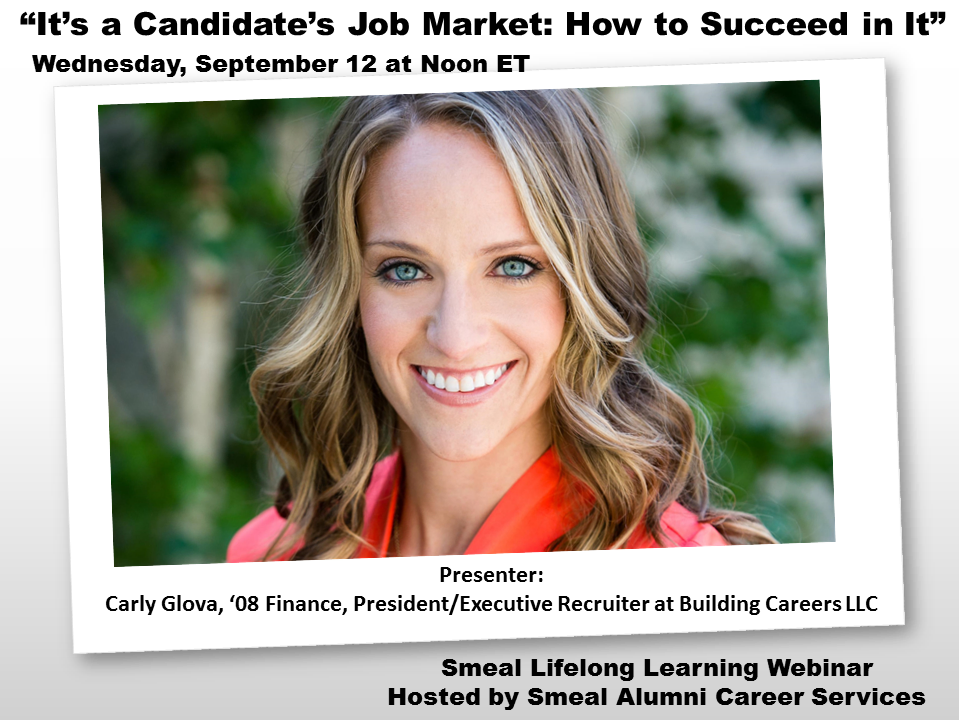
It’s a Candidate’s Job Market: How to Succeed in It

How to Succeed in a Candidate's Job Market

Join Penn State alumna, Carly Glova, ’08 Finance, for a Smeal Lifelong Learning Webinar, “It’s a Candidate’s Job Market: How to Succeed in It,” on Wednesday, September 12, at Noon ET/9:00 AM PST. Reportedly, the economy’s strengthening and both jobs and wages are moving up. Carly, Founder and Executive Recruiter at Building Careers LLC, will discuss how employers and employees can survive in this war for talent! Secure your spot today! https://bit.ly/2IqHZt

It’s a Candidate’s Job Market: How to Succeed in It Read More »

Prepare For A Successful Interview With These Tips – Part III

After the Interview

Even when the interview is over, you can still make an impression. The fact that you were singled out for an interview means the interviewer considers you a serious candidate for the position. This is why it is important to follow up after every job interview, whether it is an in-person or phone interview or a second interview.

By following up, you are acknowledging and showing appreciating for the interviewer taking time out of their busy day to speak with you. You will also be reminding the interviewer that you are qualified and strong contender for the job and that you should be given serious consideration. Below are some ways you can improve your hiring chances through following up.

Personalized Thank You Note | After the Interview

Personalized Thank You Note

Always send a personalized thank you letter or email the same day as the interview. Be genuine and write the note from scratch as a catch-all template may seem artificial.

A personal thank you note will show your sincere interest and give you one last opportunity to promote yourself for the job. Here is a general format to help you:

  1. Express gratitude for the interviewer taking the time to meet with you and sharing information about the position and the company.
  2. Mention something specific that was brought up in the meeting. Use it to demonstrate why you would be a good fit for the job and/or why you are interested in the job.
  3. Remind them of your specific qualifications and personality traits that make you the best candidate for this position.
  4. Restate your interest.
  5. Let them know you look forward to hearing from them and to contact you if they have any further questions.

Remember to proofread your follow-up responses before sending them. A grammatical or spelling error will look bad and could take you out of the running. Be especially aware of people’s names as they will notice if you spell them incorrectly.

Follow Up Phone Call

If you haven’t heard back from your prospective employer within a week, give them a follow-up call. This is another way you can convey your interest in and your qualifications for the job.

If the position requires a lot of phone time, giving them a call is an added bonus. It will give you the opportunity to show you have the strong communication skills needed for the job. Here are some tips on what to say:

  • Begin by stating who you are and using your full name.
  • Say when you met with them and the position you interviewed for.
  • Tell them thank you for considering you for the job.
  • Inquire about the status of the position that you interviewed for.
  • Ask if there is anything specific you can speak to to quell any concerns about your ability to be successful in the role.
  • Reiterate your qualifications at a high-level or mention any key points you forgot to mention during the interview.
  • Request feedback on the hiring timeline for this role and when you can anticipate hearing from them again.

If you are nervous or think you might forget what to say, make a list of points you want to bring up.

In the competitive job market of today, it is important to follow up effectively after an interview. It will set you apart from many other candidates. However, failing to do so might cause you to lose out of the position to someone else. Make sure to impress interviewers and secure the job by following these guidelines.

For additional tips on hot to prepare for an interview read Prepare for a Successful Interview With These Eight Tips – Part 1: Before the Interview and Prepare for a Successful Interview with These Eight Tips – Part II: During the Interview.

Prepare For A Successful Interview With These Tips – Part III Read More »

Prepare For A Successful Interview With These Eight Tips – Part II

During The Job Interview

You have a job interview. Congratulations! You have made it through the initial screening process – the company you are interested in has reviewed your resume and background and believes you have the expertise needed to be considered for the open position. The interview is now your opportunity to shine and convince the team interviewing you that you are the best candidate for the job. Here are some ways we recommend you do it.

Job Interview | Congratulations!

1. Remember to be confident and maintain eye contact

Keeping eye contact with the person doing the interview shows that you are genuine and self-confident.

2. Give answers that are clear and to the point

Instead of just answering a question with “yes” or “no,” explain with a little more detail. For example, if they ask, “Have you had any experience with budgets?” you can respond with a summarized, yet specific answer like “Yes, at my last company, I was responsible for creating and adhering to budgets for a 20-property portfolio.” Furthermore, make sure to talk about what you were personally in charge of when asked about team projects.

3. When asked about your salary requirements, don’t go too low or too high

If you don’t know the salary range for the position when asked this question, it’s okay. Tell them what you are currently making, including the base salary and any other payment received, like bonuses. Let them know you are flexible and will weigh all aspect of the opportunity. You want to make sure you are getting what you are worth without pricing yourself out of the position.

4. Come prepared to describe why you want to work in this position at that particular company

Before the interview, you will have done research on the company, including its press releases and reports. Doing so will help you better express why you are interested in working for them. Moreover, you will be able to state your short and long-term goals while operating as a member of their team. Employers want someone who will be with the company for a long time. Make sure to mention why you would be an asset to them now and in the future.

5. Be authentic and genuine, but remain professional

Avoid making inappropriate comments or jokes and do not share unnecessary personal information. This may cause the interviewer to make unwanted judgments about you. Be sure to stay professional and tactful in your answers.

6. Avoid talking negatively about your last company or supervisor

During an interview, it is not the time or place to speak poorly about anyone. If you do, the interviewer will wonder if you were let go or pushed out of your last job. They might think you will be an employee who whines and becomes a bad influence on other employees. This might turn them away from wanting to hire you. Instead of bashing your prior company, describe the differences between the two and why this one would be a better match and a more appealing one to work for.

7. Ask for a business card

Doing so will show that you are interested in keeping in contact. It will also give you the information to follow-up with them and send a thank you note.

8. Before leaving, communicate your interest once again

At the end of the interview, give a firm handshake and restate your interest in the job. Be sure to reiterate an example of how your specific experience would make you a fit. Also, ask if they have any more questions or concerns about your capability and skill set match for this position. Getting these last statements in will show your confidence and enthusiasm for the job. Likewise, it will give you one more opportunity to alleviate any concerns they might have and promote yourself before the interview is over.

Good luck!

For additional tips on how to prepare for an interview read Part I (Prepare For a Successful Interview with These Eight Tips) and be sure to watch for Part III (coming out this Fall) on what to do as follow-up after the interview has taken place.

Prepare For A Successful Interview With These Eight Tips – Part II Read More »

Prepare For a Successful Interview with These Eight Tips – Part I

Before the Interview

Navigating your career in today’s job market takes strategic persistence and a lot of patience. So when you actually do manage to get “a foot in the door” and time on someone’s very busy calendar, it’s important to fully prepare yourself for the best interview possible. Here are some recommendations we typically run through with candidates to address before the interview.

1. Research the Company and Interviewer

To start, look up information on the person conducting the interview and on the company’s website. Then search for any reports or news articles about the company. It is important for you to know about the place you are applying for so that you can make your skills and experience relevant to them.

2. Look Over the Details of the Job

Make sure you have a firm grasp on the requirements of the position. That way, you can be prepared to share examples of your training and skills that relate specifically to the job description.

3. Come Prepared with a Few Questions

Allow the person interviewing to be in charge of the discussion, but try to ask a few questions. Be sure the questions reflect your commitment and desire to work for the company.

4. Practice the Interview with Someone

Doing a trial run of an interview will help you feel more confident in your answers. It will also help you work out the kinks of your delivery. Rehearse with someone who will give you honest feedback so that you can do your best during the real interview.

5. Edit Your Social Media Profiles

Before choosing who to hire, it is common for companies to look up public information about potential candidates. Therefore, it is important that you privatize or get rid of any tasteless or embarrassing references, pictures, etc.

6. Bring Multiple Copies of Your Resume

Resumes need to be proofread and look professional. Even though you have already submitted your resume to the company, bring a copy for each person that you will be speaking with during the interview.

7. No Cellphones

Even while you are waiting to be interviewed, turn off your cell phone or leave it in the car. It is unprofessional to use it or allow it to distract you during an interview.

8. Dress in a Professional Manner

Last but certainly not least, no matter where you have the interview, or what the company’s dress code is, make sure to look professional. A suit, tie, and dress shoes for men or similar attire for women will make a great first impression and help you look successful. Don’t forget to shave and brush/groom your hair.

By following these eight preparation tips, you can feel confident when going on your interview. Click here to learn more about how to best conduct yourself during (Part II) and after (Part III) an interview.

Prepare For a Successful Interview with These Eight Tips – Part I Read More »

Skip to content