According to the article “Try These 7 Hacks to Crush Your First Leadership Role“, only 4% of millennials had an interest in managing others. Nearly half of that generation, however, are already managing people. Admittedly, most companies do not have a great process in place to train and nurture these leaders. The seven suggestions below are ways millennial leaders can prepare for their future management responsibilities:
Exercise your emotional intelligence and admit when you don’t know something
Ask intelligent and thoughtful questions
Associate with your own cheering section of mentors and sponsors
Be authentic and vulnerable in all of your interactions
Work hard and put in the extra time
Take note of and work to address others concerns
Appreciate and enjoy the opportunity
Published by Dan Negroni on LinkedIn on December 1, 2017.
From major mergers and capital constraints on apartments to the co-working revolution and the Fed finally making its move on interest rates, 2016 was not without its major commercial real estate stories. But, of course, the biggest one of all won the American presidency. See below for the major commercial real estate news highlights on 2016.
Enter Donald Trump
Marriott International Grows With Starwood Merger
Creation of ColonyNorthStar
China Becomes Major US Real Estate Investor
Banks Pull Back On Apartment Construction Lending
Merger Mania In Dixie
Hines REIT Liquidation
Fed Makes Its Move. Finally.
The VTS/Hightower $300M Merger
Co-Working Takes The US By Storm
Originally published by Jarred Schenke for Bisnow on Dec 23, 2016. See additional details on these commercial real estate 2016 highlights in the full article here: The Biggest Commercial Real Estate Stories Of 2016
With Amazon’s September announcement that is will be building another Seattle-sized headquarters, cities put their best and most creative brainpower into telling Amazon why they should choose their city.
What’s in it for the chosen finalist? A campus the size of it’s current Seattle headquarters, $5 billion in construction spend, and 50,000 plus high-paying jobs.
Numerous cities have been named as stand out candidates including New York City, Denver, Austin, Boston, Chicago and Washington, D.C., Detroit, Pittsburgh, Minneapolis, and Baltimore. The site of the new headquarters will undoubtedly need to have quality higher education, functional infrastructure, and significant government backing.
Finalists are announced in December with the winning location to be announced in 2018. We are all excited to see which city gets economic boost from the Amazon powerhouse.
Read more about thoughts on the expansion by some of NAIOP’s Distinguished Fellows:
How Interviewing for Jobs is Like Playing The Dating Game
Searching for a new job, whether currently employed or not, can be a frustrating and tedious process. I often work with candidates who are struggling to find “the right” position and company. Some are exasperated because it’s taking too long and others are discouraged because they are seeing a lot of opportunities in the market but none quite right for them.
In order to help candidates have more patience and understand the process, here’s what I tell them: Job hunting is a whole lot like dating. Finding the right partner doesn’t happen overnight and in the meantime there’s a lot of trial and error that must take place.
The same is true with job hunting. The saying, “you have to kiss a lot of frogs,” is similar to my sentiments when it comes to interviews. While interviews can be hard to get, nerve-wracking once they’re scheduled, and sometimes not lead to a match, they are a crucial part of finding the right fit. Going on interviews, like going on dates, is how you determine your likes and dislikes and your must-haves and can-live-withouts. Interviewing is how you get an overall sense of a company and the open position and whether or not you will be fulfilled – professionally and personally – and where your contributions will be needed and recognized.
What I also share with candidates is: When in doubt, submit your resume and go on the interview. Submitting a resume through a recruiter who has a close partnership with the company you’re interested in gives you a much stronger chance of making sure your resume is seen by the hiring managers. It’s an initial stamp of approval similar to being introduced by mutual friends in the dating world. If the company is interested in meeting with you but you’re hesitant that it’s not the right fit, go anyway. You may be pleasantly surprised and realize it’s your dream job (trust me, it happens all the time) and if it falls short, then you walk away with added industry knowledge and a solid hour of interview practice.
I personally have faced the frustration and ups and downs of the job search process. Having jumped in headfirst to a few positions then realizing they weren’t right for me, I had to start again. I took this time to really do my industry research, connect with my network and go on plenty of interviews. It took me three wrong positions to figure out what the right one was, but I had faith in the process and now couldn’t have asked for a better professional match.
When all else fails, keep trying. Eventually most people realize it’s better to keep “dating,” seeing what positions and companies are out there, and making sure there’s a mutual fit before jumping to the next job. Remember, it’s just a process and in the end, it works out as it should.
By: Julia Turpit, Director | Recruiting Consultant
Effective January 1, 2018. California employers will no longer be able to ask your previous or current salary. Applicants are free to volunteer this prior compensation information, and companies may then consider than information in their offer packages. Companies will also now be required to provide applicants a salary range for open positions.
The goal of this legislation is to narrow the gender pay gap. “In 2016, California women who were full-time wage and salary workers had median weekly earnings of $814 or 88 percent of the $925 earnings of their male counterparts, the U.S. Bureau of Labor Statistics reported last month. That’s down from 90.2 percent in 2005.”
The NAIOP CRE Sentiment Index for September 2017 indicates that commercial real estate fundamentals are generally positive, but there is still some uncertainty. An index number greater than zero, like the current 0.49 number, indicates that respondents believe that general market conditions over the next 12 months will continue to be favorable for the commercial real estate industry, and overall conditions will be better in 12 months than they are today. This survey reflects an expectation that the commercial real estate market will be moving ahead at a more cautious pace than what was expected six months ago, and at about the same pace as measured one year ago.
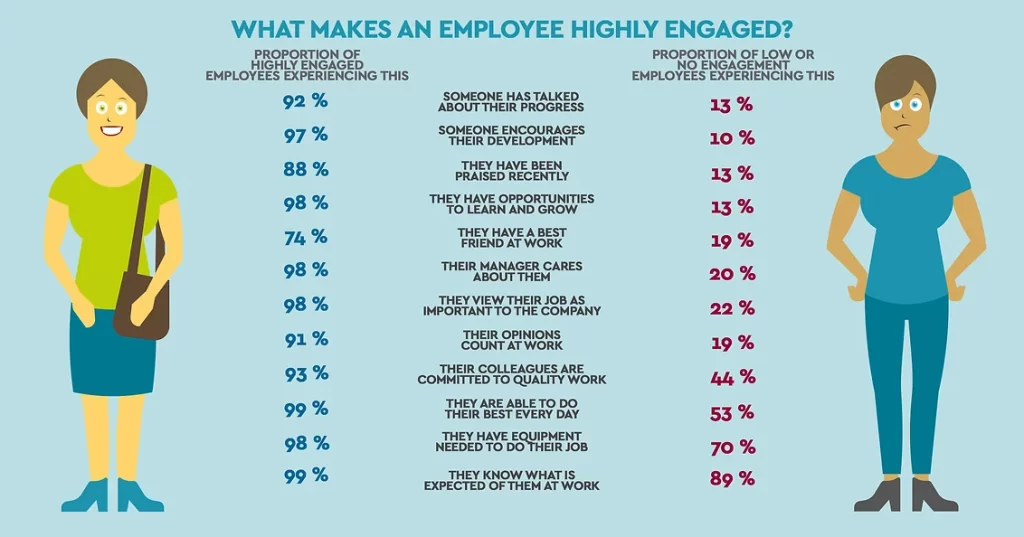
The infographic below highlights what highly engaged employees experience at work. This may help you determine what it takes to have highly engaged employees. Generally speaking, the highly engaged employees feel recognized, valued and involved.
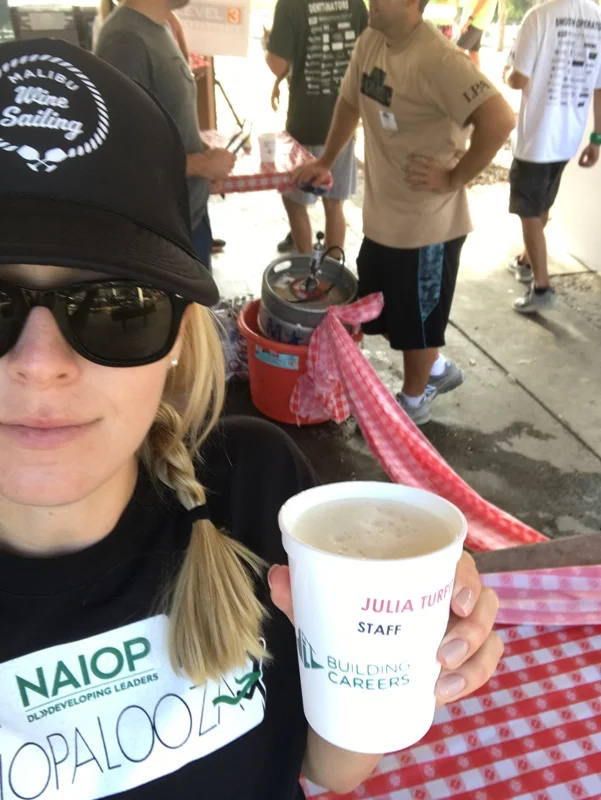
Building Careers proudly sponsored NAIOP San Diego’s NAIOPalooza 2017 benefiting HomeAid San Diego. A special shout out to Julia Turpit and her event team for putting on a successful event!
NAIOP’s CRE.Converge 2017, held in Chicago October 10-12 brought together over 1,500 professionals from across North America for networking, deal-making and lively discussion.
Above is a link to NAIOP’s conference recap, including industry thoughts on geopolitical trends, disruptive technologies, global economic investments, and strategic development approaches. Especially interesting to me was the discussion on the fourth wave of wealth and prosperity. Want to get ahead of the wealth curve? Find out what keynote speaker Dr. Michio Kaku shared surrounding his big-picture predictions for The Fourth Wave of Wealth and Prosperity its implications for commercial real estate.
Even when the interview is over, you can still make an impression. The fact that you were singled out for an interview means the interviewer considers you a serious candidate for the position. This is why it is important to follow up after every job interview, whether it is an in-person or phone interview or a second interview.
By following up, you are acknowledging and showing appreciating for the interviewer taking time out of their busy day to speak with you. You will also be reminding the interviewer that you are qualified and strong contender for the job and that you should be given serious consideration. Below are some ways you can improve your hiring chances through following up.
Personalized Thank You Note
Always send a personalized thank you letter or email the same day as the interview. Be genuine and write the note from scratch as a catch-all template may seem artificial.
A personal thank you note will show your sincere interest and give you one last opportunity to promote yourself for the job. Here is a general format to help you:
Express gratitude for the interviewer taking the time to meet with you and sharing information about the position and the company.
Mention something specific that was brought up in the meeting. Use it to demonstrate why you would be a good fit for the job and/or why you are interested in the job.
Remind them of your specific qualifications and personality traits that make you the best candidate for this position.
Restate your interest.
Let them know you look forward to hearing from them and to contact you if they have any further questions.
Remember to proofread your follow-up responses before sending them. A grammatical or spelling error will look bad and could take you out of the running. Be especially aware of people’s names as they will notice if you spell them incorrectly.
Follow Up Phone Call
If you haven’t heard back from your prospective employer within a week, give them a follow-up call. This is another way you can convey your interest in and your qualifications for the job.
If the position requires a lot of phone time, giving them a call is an added bonus. It will give you the opportunity to show you have the strong communication skills needed for the job. Here are some tips on what to say:
Begin by stating who you are and using your full name.
Say when you met with them and the position you interviewed for.
Tell them thank you for considering you for the job.
Inquire about the status of the position that you interviewed for.
Ask if there is anything specific you can speak to to quell any concerns about your ability to be successful in the role.
Reiterate your qualifications at a high-level or mention any key points you forgot to mention during the interview.
Request feedback on the hiring timeline for this role and when you can anticipate hearing from them again.
If you are nervous or think you might forget what to say, make a list of points you want to bring up.
In the competitive job market of today, it is important to follow up effectively after an interview. It will set you apart from many other candidates. However, failing to do so might cause you to lose out of the position to someone else. Make sure to impress interviewers and secure the job by following these guidelines.